
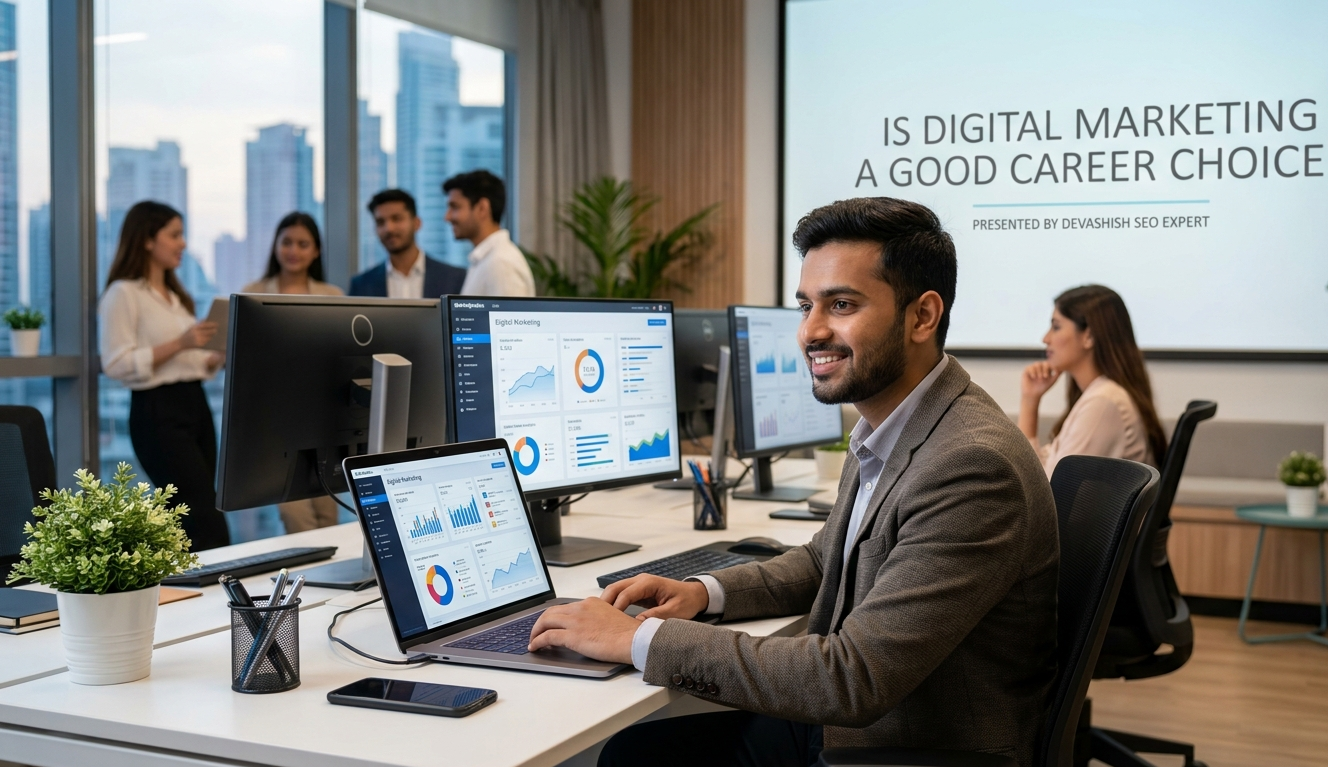
Is Digital Marketing Really a Good Career?
From SEO and social media to data analytics and paid ads — digital marketing has become one of the most versatile, in-demand, and well-paying career paths of the modern era.
$860B+ Global digital ad spend by 2026
860K+ Open DM jobs in India alone
32% Faster job growth vs average
100% Remote-friendly roles available
The World Has Gone Digital — And It Needs Marketers
There was a time when marketing meant newspaper ads, television commercials, and billboards by the highway. That world hasn’t disappeared — but it has been fundamentally transformed. Today, more than 5.4 billion people use the internet, and businesses of every size are fighting for their attention online. The result? An enormous, growing, and beautifully diverse field called digital marketing — and a career opportunity that didn’t exist at scale just two decades ago.
Whether you are a student choosing a career path, a professional considering a switch, or an entrepreneur wanting to grow your own business, digital marketing offers something genuinely rare: the combination of creativity, analytical thinking, flexibility, and financial reward — all in a single discipline.
What Does a Digital Marketer Actually Do?
Digital marketing is not a single job — it is an ecosystem of specialisations, each requiring its own skills and knowledge. A digital marketer could spend their day writing compelling content, optimising a website for Google, managing paid advertising campaigns on Meta, analysing conversion data, building email funnels, or growing a brand’s social media presence. Some professionals master one specialty deeply; others develop a broad “T-shaped” skill set across multiple channels.
The core domains of digital marketing include: search engine optimisation (SEO), pay-per-click advertising (PPC), social media marketing, content marketing, email marketing, affiliate marketing, influencer marketing, marketing analytics, and conversion rate optimisation (CRO). Each of these is a legitimate career path on its own, and many professionals build entire agencies and consultancies around just one of them.
“Digital marketing is one of the few careers where a 22-year-old with a laptop and the right skills can earn more than a seasoned professional in a traditional field.”
Career Roles and Salary Potential in India
One of the strongest arguments for choosing digital marketing as a career is the sheer range of roles available — and the salaries attached to them. The field rewards skill and results over years of experience, which means fast learners can climb the ladder surprisingly quickly.
SEO Specialist
₹3L – ₹10L per year
PPC / Paid Ads Manager
₹4L – ₹14L per year
Content Strategist
₹4L – ₹12L per year
Social Media Manager
₹3L – ₹9L per year
Email Marketing Manager
₹4L – ₹11L per year
Digital Marketing Manager
₹8L – ₹25L per year
Marketing Analytics Lead
₹10L – ₹30L per year
Freelancer / Consultant
Unlimited potential
Salaries grow significantly with experience and specialisation. A performance marketing manager with 5–7 years of experience at a top startup or MNC in India can comfortably earn ₹20–35 LPA. Freelancers who build an international client base often earn even more, billing in USD or GBP while working from anywhere in the country.
Why Digital Marketing Is a Future-Proof Career
One of the most common fears about any career in technology is obsolescence — will artificial intelligence or automation make this role redundant? Digital marketing, while evolving rapidly with AI, is not at risk of disappearing. In fact, AI is making digital marketers more powerful, not replacing them. Tools like ChatGPT, Jasper, Midjourney, and Google’s AI-driven ad systems augment what marketers can do — but human strategy, creativity, empathy, and brand understanding remain irreplaceable.
Furthermore, as long as businesses need customers — which is to say, forever — they will need digital marketing. Every new platform that emerges, every new technology that rolls out, creates new channels for marketers to explore. The professionals who thrive will be those who combine technical skills with genuine human insight. That combination is not something any algorithm can fully replicate.
The Skills You Need to Succeed
Unlike medicine or law, digital marketing does not require a specific degree. What it does require is a genuine commitment to continuous learning. The landscape shifts constantly — Google updates its algorithm hundreds of times a year, Meta changes its ad formats, new platforms like LinkedIn’s short video push or WhatsApp’s business channels open up fresh opportunities. Successful digital marketers are, above all else, lifelong learners.
The essential skills divide into two categories: technical and soft. On the technical side, you need to understand SEO fundamentals, Google Ads and Meta Ads platforms, Google Analytics and GA4, basic HTML/CSS for email and landing pages, CRM tools, and ideally some experience with marketing automation platforms like HubSpot or Mailchimp. On the soft skills side, strong written communication, analytical thinking, creativity, curiosity, and the ability to understand consumer psychology will take you further than any certification alone.
SEOGoogle AdsMeta AdsContent WritingGA4 AnalyticsEmail MarketingA/B TestingCopywritingCRM ToolsData Analysis
Flexibility, Freelancing, and the Freedom Factor
Perhaps the most underrated benefit of a digital marketing career is the sheer flexibility it offers. Unlike most professions, digital marketing is inherently location-independent. A skilled SEO consultant in Meerut can serve clients in Mumbai, London, and New York — all from the same desk. Remote work is not a perk in this field; it is the norm. This makes digital marketing an exceptional career for people in smaller cities who want access to national and international opportunities without relocating.
The freelancing economy within digital marketing is massive and growing. Platforms like Upwork, Fiverr, LinkedIn, and even direct referrals allow talented marketers to build client rosters and income streams that often exceed what a full-time job would offer. Many professionals start in agencies or in-house roles to build their skills and portfolio, then transition into consulting or freelancing once they have the confidence and connections to do so.
How to Get Started: A Practical Roadmap
The good news is that there has never been more accessible, affordable, and high-quality education in digital marketing than right now. Google offers free certifications in Google Ads, Analytics, and digital fundamentals. Meta Blueprint covers social media advertising. HubSpot Academy provides excellent free courses on content marketing, email marketing, and inbound strategy. For structured learning, platforms like Coursera, Simplilearn, and IIDE offer comprehensive digital marketing programmes recognised by employers.
The most important step, however, is not taking courses — it is building real experience. Start a blog, manage a social media page, run a small Google Ads campaign with a modest budget, do an internship, or offer your services to a local business for free or at a reduced rate. Portfolio work speaks louder than any certificate when you are applying for your first role. The field rewards those who do, not just those who study.
Frequently Asked Questions
Salary figures are indicative based on industry averages as of 2026. Actual compensation varies by city, company size, an experience.
Q1. Is digital marketing a good career in India in 2026? Yes, absolutely. India’s digital economy is growing at an extraordinary pace, with over 900 million internet users and e-commerce, edtech, fintech, and D2C brands expanding rapidly. The demand for digital marketing professionals far outpaces the supply of qualified talent, making it one of the best career choices available today — especially for those in Tier 2 and Tier 3 cities who can access remote and freelance work.
Q2. Do I need a degree to work in digital marketing? No formal degree is required. Most employers care far more about your skills, portfolio, and results than your educational credentials. Many of the best digital marketers are self-taught or have completed focused online certifications from Google, Meta, or HubSpot.
Q3. Will AI replace digital marketing jobs? AI will automate some repetitive tasks but will not replace the strategic, creative, and relational aspects of marketing. Marketers who learn to use AI tools effectively will become significantly more productive. The risk is not AI replacing marketers — it is marketers who use AI replacing those who don’t.
Q4. How long does it take to become a digital marketer? You can learn the fundamentals in 3–6 months. To become job-ready with a solid portfolio, plan for 6–12 months. Mastery in a specialisation like SEO or performance marketing typically takes 2–3 years of hands-on experience.
Q5. What is the starting salary for a fresher in digital marketing? Fresher salaries in India typically range from ₹2.5–4.5 LPA for entry-level roles. With strong certifications and a portfolio, some freshers secure ₹5–6 LPA. Freelancers with basic skills can earn ₹20,000–50,000 per month from their first few clients.
Q6. Which specialisation in digital marketing pays the most? Performance marketing (paid ads/PPC) and marketing analytics tend to command the highest salaries. Growth marketers who combine data, experimentation, and cross-channel strategy are among the highest-paid professionals in the field.
Q7. Can I work remotely as a digital marketer? Yes — digital marketing is one of the most remote-friendly careers that exist. As a freelancer, you can serve clients across the country or internationally with just a laptop and a reliable internet connection.
Q8. What are the best free resources to learn digital marketing? Google Skillshop, Meta Blueprint, HubSpot Academy, Semrush Academy, Moz Blog, Neil Patel’s blog, Backlinko, and YouTube channels dedicated to SEO and paid advertising — most are completely free and industry-recognised.